

An Introduction to the Compound Effect
In short: The compound effect is what happens when your gains start earning gains of their own. Growth looks slow at first, then speeds up sharply, which is why starting early matters more than starting big.
What if your money, skills and habits could grow on their own, faster every year?
That is what the compound effect does.
The compound effect is how small, steady gains turn into large results over time. Many successful investors say it built most of their wealth.
But what exactly is it, and how can you use it to your advantage? The following introduction will tell you everything you need to know about this powerful financial tool.
Compound growth story
Let’s start with the old story of the chessboard and the rice.
A king offered the inventor of chess any reward he wanted. The inventor asked for one grain of rice on the first square, two on the second, four on the third, doubling on every square until all 64 were filled. It sounds like a silly request, doesn’t it?
But let’s take a minute to do this calculation.
- 1st square = 1 grain
- 2nd square = 2 grains
- 3rd square = 4 grains
- 4th square = 8 grains
- .
- .
- 17th square = 65,536 grains
- .
- 33rd square = 4,294,967,296 grains
- .
- 64th square = 9,223,372,036,854,775,808 grains
Now add up every square.
All 64 squares together hold 18,446,744,073,709,551,615 grains: hundreds of billions of tonnes of rice, far more than the world has ever grown.
Doubling looks small at the start and enormous at the end. That is the compound effect.
A popular saying, often wrongly credited to Albert Einstein, puts it this way: “Compound interest is the eighth wonder of the world. Those who understand it earn it. Those who don’t pay it.”
Now you have a feel for what the compound effect is.
Here is how to put it to work.
Start with baby steps
It doesn’t matter how big your vision is, or how much money you want to make. Start with small changes, and focus on creating a habit.
If your goal is to earn $1 million a year, you won’t get there overnight. But you can build a spending plan that frees up an extra $100 a month, save half of it, and invest it for growth, one month at a time.
Baby steps add up over time. Small consistent improvements will not only change your life in 10 years. They will also change your life today.
The compound effect works when you start with baby steps because it requires patience.
Don’t rush. Increase your pace gradually, and let consistency do the compounding.
Over time, those small amounts grow into hundreds and then thousands. As your expenses decrease and your income increases, you’ll find yourself financially free sooner than expected.
You just have to start today. One day at a time!
Measure your results
After you’ve begun measuring results, take a step back and evaluate how things are going.
Are you seeing improvements? If so, that’s great.
Take another look at your goals, figure out what’s working and keep doing more of it. However, if you haven’t seen any improvement, or if things seem to be getting worse, you need to make changes.
Figure out what isn’t working and ditch it so that you can get back on track towards your goals quickly. Otherwise, you may not meet your long-term financial goals when it comes time for retirement!
You won’t be perfect at anything at first. But by spending just 20 minutes each day sharpening that skill, you’ll start improving with each iteration. Before long, you’ll be better than most people in that field and be able to charge more for your services as well!
Repeat the process again and again
The compound effect is a long-term approach, where slow and steady progress is made over time.
While it’s more laborious than a short-term effort, compounding interest can lead to huge results over time.
This concept is used in investing, and many people use it to increase their earnings.
If you set aside some amount of money each month for twenty years, that sum would make an enormous difference in your retirement portfolio.
In life, you might put off bettering yourself for too long, thinking there isn’t enough time, but when you look back on it all at 65, forty years from now probably seems like plenty of time.
Don’t wait to start making healthy choices today—you’ll thank yourself later.
Practical quiz
Remember the chessboard story? Now answer this quickly.
Choice 1: You get $100 million today.
Choice 2: You get $1 today, and the amount doubles every day for 30 days.
What would be your choice?
Let’s do the maths again.
- Day 1 = $1
- Day 2 = $2
- Day 3 = $4
- .
- Day 21 = $1,048,576 (about $1 million)
- .
- Day 27 = $67,108,864 (about $67 million)
- .
- Day 30 = $536,870,912 (about $537 million)
Up to day 27, choice 2 is still worth less than choice 1. In the last three days it overtakes choice 1 and ends at more than five times its value.
Most people pick choice 1. Once you understand the compound effect, choice 2 is the obvious answer.
Final tips
Long term thinking is something most people neglect when planning out their goals.
Long term planning is a skill that needs to be developed, however many small actions done consistently and over a long period of time can generate large positive outcomes.
Take Ray Kroc, who built McDonald’s into a global franchise. He started as one salesman with an idea and grew it into one of the biggest franchises in history, one door at a time.
He constantly kept his eye on where he wanted to go rather than get caught up in individual doors or specific jobs.
His approach was simple: small gains, repeated over a long time.
So have faith in your ability to succeed if you remain persistent and think about achieving things not once but multiple times for consistency and victory will eventually come your way.
A real-life example
You have probably heard of the investor Warren Buffett.
The chart shows how his net worth grew over time through compounding.
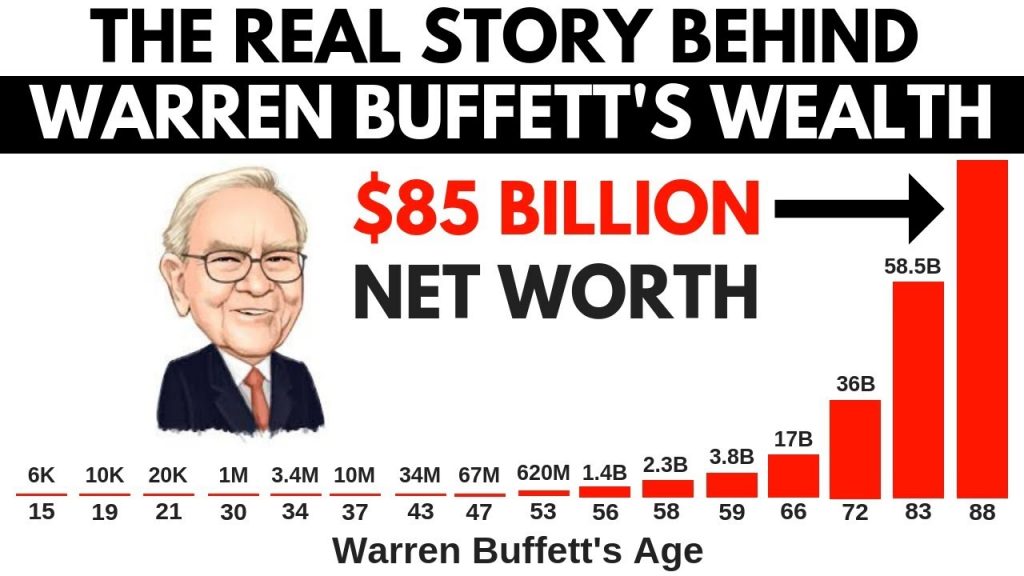
Most of his wealth was built late in life, after decades of compounding.
Key takeaways
Habits that help your progress compound:
- Use every opportunity offered to network with people
- Stay focused
- Develop discipline
- Remain committed to being better
- Avoid distractions while working on important tasks
- Use benchmarks
- Measure progress
- Learn how to automate routine work
Compounding works best on investments you understand. Before you buy a Sri Lankan stock, you can estimate what it is worth with our free fair value calculator.
Browse topics
Value a CSE stock in under a minute
Free fair value calculator for 290+ CSE companies. DCF, P/E and NAV, with the method picked for each sector.
Open the calculator →